Case Study: How We Scaled Dropshipping in Google Shopping via Agency Accounts (20 Accounts, €100k+ Spend)
Introduction: Dropshipping in the Age of Total Moderation
The e-commerce landscape of 2024 – 2026 is fundamentally different from what we saw five years ago. While the primary barrier to entry used to be price competition or supply chain logistics, today the main filter is infrastructural resilience.
Google Ads – and specifically the Google Shopping placement – remains the “Holy Grail” for commodity businesses. The reason is simple: User Intent. Unlike social media, where demand is generated artificially through “interruptive marketing,” a user in Google Shopping arrives with a formed intent to purchase. This ensures conversion rates that are often unattainable in other traffic sources.
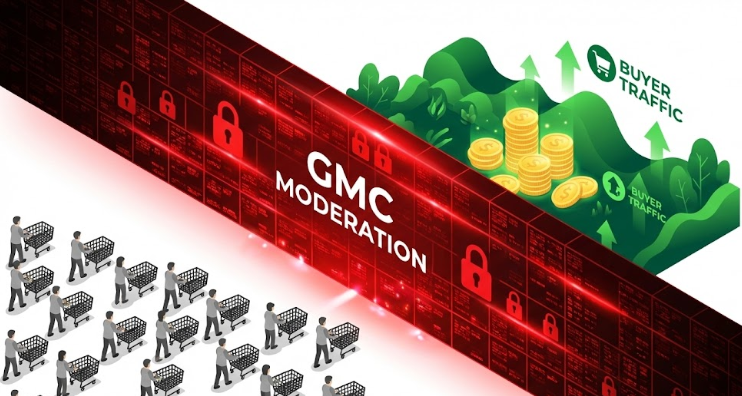
However, for the Dropshipping vertical (direct delivery from supplier to customer), Google has built a wall of moderation algorithms. Google Merchant Center (GMC) has become the primary bottleneck. Any discrepancy in the feed, a shipping delay, or a single user complaint can lead to the instant suspension of not just an ad account, but the advertiser’s entire digital identity.
In this case study, we will dissect how the ScroogeFrog team solved the problem of stable traffic for a client operating in one of the riskiest yet most profitable niches. We will demonstrate how an infrastructure of 20 agency accounts allowed us to process hundreds of thousands of Euros in budget and survive ban waves that would have wiped out any solo buyer.
The Problem: Why Solo Media Buying in Google Shopping is Dying
To understand the value of the solution, one must deeply understand the problem. Why did the client come to the conclusion that they needed to constantly rotate accounts?
The Anatomy of a Google Merchant Center Ban
The primary reason for account rotation, as noted in the project data, is the “Google Merchant Ban.” For dropshipping, this is routine. Google’s algorithms (especially following the core updates of 2024 and 2025) are tuned to detect patterns characteristic of “low-quality” sellers:
- Lack of physical inventory.
- Extended shipping times.
- Scraped or duplicated content.
When a standard user (a solo media buyer) registers an account on their personal Gmail and links a personal credit card, they enter a “grey zone” of trust. At the first spike in budget or the first minor policy flag, the trigger is pulled.
The “Death Spiral” of Self-Registered Accounts
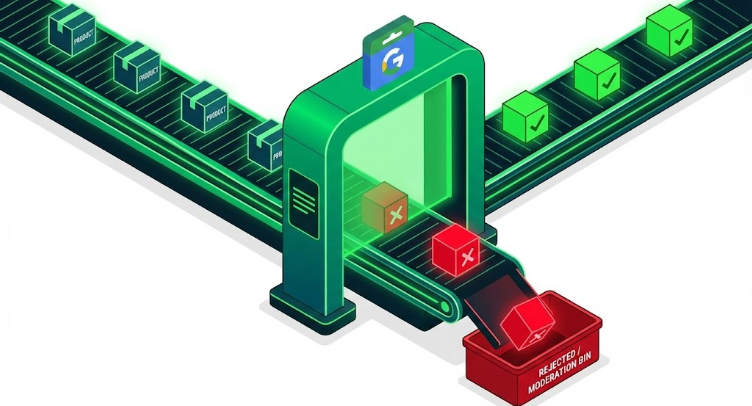
The problem isn’t the ban itself, but the consequences for the infrastructure:
- Payment Method Blacklisting: Once an account is suspended for policy violations (e.g., “Misrepresentation”), the credit card linked to it is flagged as “toxic.” Using this same card on a new account will lead to an immediate ban for “Circumventing Systems.”
- Capital Lock-up: In standard accounts, refunding the remaining balance after a ban is a bureaucratic nightmare that can take anywhere from 2 weeks to 3 months. For a dropshipper, where cash flow is king (paying suppliers, funding traffic), having $5,000 frozen is equivalent to business death.
- Time Loss: Appeals via standard support forms are handled by bots. The chance of being reinstated without the intervention of a human representative is statistically near zero.
This is the exact set of problems our client faced in mid-2024: the inability to scale above a certain limit and constant downtime spent hunting for new cards and warming up accounts.
Project Data: The Hard Numbers & Objectives
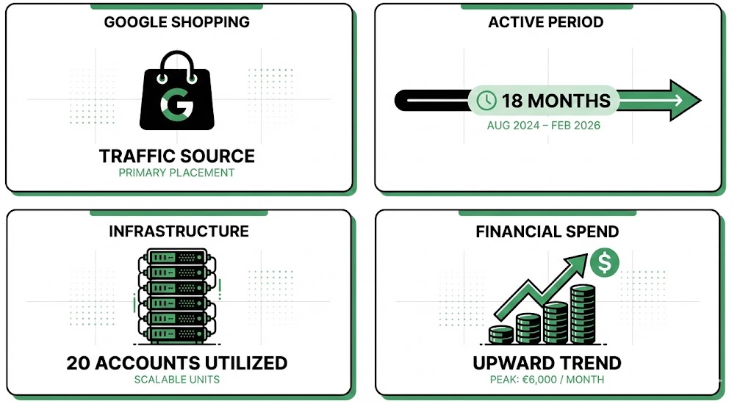
Let’s move to specifics. In August 2024, we initiated a partnership with the goal of building a fault-tolerant traffic procurement system.
Project Passport:
- Traffic Source: Google Ads.
- Primary Placement: Google Shopping
- Vertical: E-commerce (Dropshipping).
- Active Period: August 2024 – Present (February 2026).
- Total Accounts Utilized: 20 units.
- Peak Spend per Account: Up to €5,000 – €6,000 per month.
- Current Status: 5 active accounts in rotation.
- Current Average Spend: ~€2,000 per month per account.
Key Objective:
To demonstrate practically that Google Ads is a stable and, most importantly, scalable traffic source when working through agency accounts, even under conditions of regular moderation bans.
The Technical Solution: Agency Infrastructure as the Foundation
The solution was the integration of the client into the ScroogeFrog Agency Accounts ecosystem. What is the fundamental difference between “John Doe’s Account” and our agency cabinet?
Trust Score & Billing
Google ranks advertisers not only by ad quality but by the trust level of their billing method.
Our accounts operate on a Monthly Invoicing (Credit Line) system. This means Google allows the ads to run first, and the invoice is issued at the end of the month. This payment type is only available to large agencies that have passed strict compliance checks.
The Result for the Client: An account with a credit line is a priori considered “white-listed” regarding payments. It does not get banned for “Suspicious Payments” during sharp budget increases. We were able to launch campaigns with budgets of €200–300/day from Day 1, bypassing the long weeks of “warming up” that are mandatory for self-registered accounts.
The Rotation Workflow
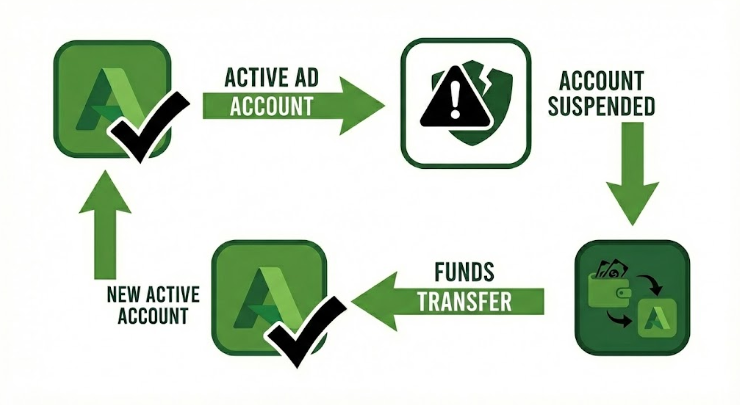
We implemented a protocol where an account ban was treated not as an emergency, but as a technical iteration.
Monitoring: The system tracks the Google Merchant Center status.
Incident: A ban occurs (e.g., for data quality/Misrepresentation).
Action: We do not waste time on hopeless attempts to resuscitate a “dead” cabinet via standard forms.
Replacement: The client is issued a new, “fresh” sub-account from our MCC (My Client Center).
Transfer: The budget from the old account is transferred to the new one.
This scheme allowed us to utilize 20 accounts over a year and a half, maintaining traffic continuity
Operational Timeline (Aug 24 – Today)
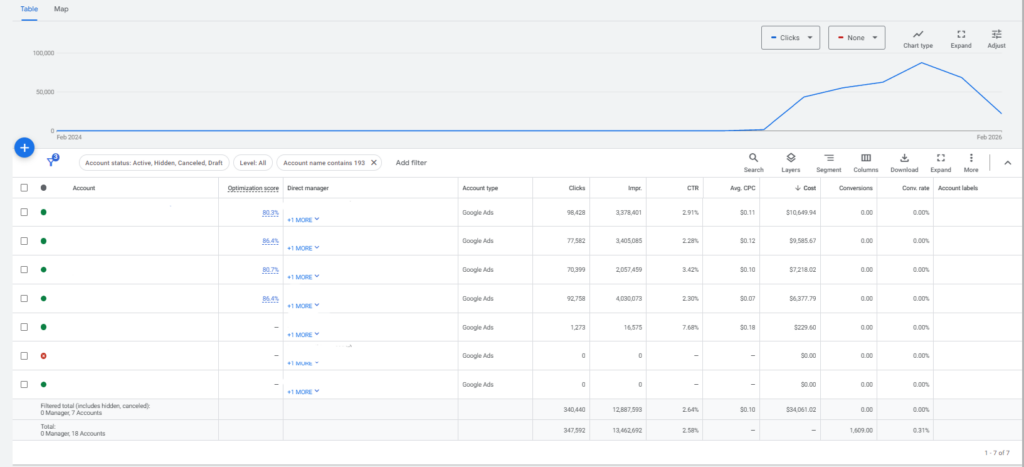
Let’s look at the project’s development dynamics through the numbers.
Phase 1: Aggressive Start (August – December 2024)
During this period, we tested the limits of the niche.
Average spend per account reached €5,000 – €6,000.
This was a “stress test” period. At such traffic volumes, attention from Google moderators is at its peak. This phase accounted for the majority of account rotations.
Insight: We discovered that even with high spend, an agency account lives significantly longer than a self-reg, allowing enough budget to be spent to generate significant profit before any issues arise.
Phase 2: Stabilization & Optimization (January 2025 – February 2026)
Based on the data gathered, we adjusted the strategy. Instead of trying to “squeeze” the maximum out of a single account until its inevitable death, we shifted to a diversification tactic.
- Current Structure: 5 active accounts running in parallel.
- Load: ~€2,000 per account per month.
- Logic: By distributing the budget (the same €10,000 total) across 5 accounts, we reduce the risk of a total business stoppage. If one account goes under review, the other 4 continue to generate cash flow.
Deep Analysis of Advantages
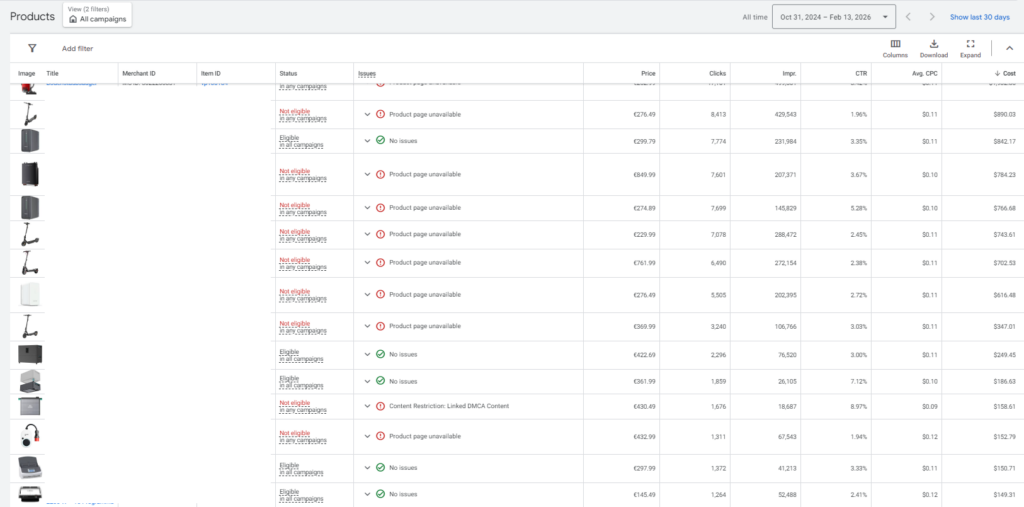
The objective was to reveal the specific benefits of working through agency accounts. Let’s break them down in detail.
1. Reliable Credit Line (Payment Method)
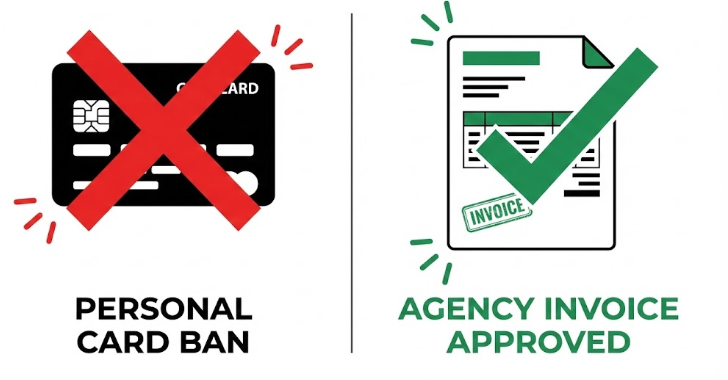
In dropshipping, Problem #1 is “Suspicious Payments.” Google hates the virtual cards (Wise, Revolut, etc.) that buyers often use. The Agency Account completely eliminates this issue. Google sees that the bill is being paid by ScroogeFrog Agency – a Google Partner – not an anonymous user. This provides “immunity” from financial bans.
2. Constant Support
The difference between talking to a bot in chat and talking to a live agency manager is colossal. We act as a buffer between the client and Google.
- If a ban is erroneous, we can escalate the request directly to Google managers.
- If a ban is justified, we immediately tell the client “don’t waste your time,” and issue a replacement.
This saves weeks of waiting.
3. Rapid Account Replacement & Fund Transfer
This is the key element of the case study. In a standard setup, if Google blocks an account with a $1,000 balance, that money is stuck. To get it back, you must close the account and wait up to 30 days for a refund to the card.
In our ecosystem, the money sits on the agency balance. If Account A is banned, we simply rewrite the virtual balance to Account B.
- Ad Downtime: Reduced from 2 weeks to <24 hours.
4. Scalability Simplicity
The case showed that scaling in Google Shopping isn’t just about increasing the budget (Scale Up), but also about increasing the number of accounts (Scale Out).
Having access to an unlimited number of agency cabinets, the client could request +3 accounts for a new product category or a new GEO at any moment, without worrying about creating new emails, anti-detect browser profiles, or proxies.
The Economics of Stability: Comparative Analysis
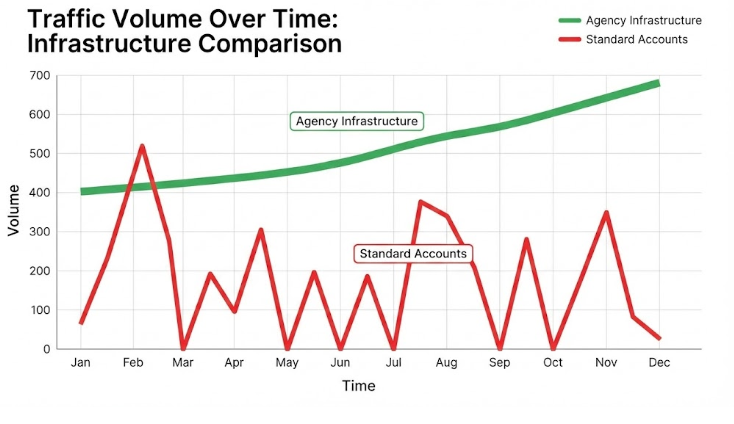
To understand the value of the 20 accounts used, let’s compare the economics of the process.
| Parameter | Independent Farming (Self-Reg) | ScroogeFrog Agency Accounts (This Case) |
| Launch Time | 3-5 days (farming, warming up) | 2-4 hours (access granted) |
| Payment Risks | High (card bans, fund holds) | Zero (invoicing, balance transfer) |
| Reaction to Ban | Loss of account, card, and domain | Account replacement, funds saved |
| Spend Ceiling | Often limited to $50/day at start | High limits available from Day 1 |
| Appeals | General queue (weeks) | Priority support |
Over 18 months of operation, we used 20 accounts. If the client had been working independently, every ban would have meant losing the remaining funds on the card and a workflow pause of at least 5-7 days.
- 20 bans * 5 days downtime = 100 days of total business stoppage.
- With agency accounts, total downtime was no more than 20 days (approx. 1 day per replacement).
- Gain: 80 extra days of active trading. At a turnover of even €1,000 per day, that is €80,000 in preserved revenue.
Conclusion
This case study vividly demonstrates that in 2026, success in media buying is determined not so much by secret targeting settings or “magical” creatives, but by the reliability of the rear guard.
Google Shopping has confirmed its status as an effective and alternative placement for e-commerce. Even in an aggressive vertical like dropshipping, a systematic business can be built.
The secret to the survival of this project is simple:
- No attachment to a single account (The “Expendable Resource” mindset).
- Use of agency-trusted payment methods.
- Risk diversification across 5 active cabinets.
We proved that even with regular bans (having cycled through 20 cabinets), it is possible to maintain a stable traffic volume and an average spend of ~€2,000 per account, scaling while competitors wait for unbans.