Remerge: The Anatomy of an In-App Retargeting Powerhouse in the Post-ATT and Privacy Sandbox Era
The era of endlessly and blindly pouring money into cold traffic has reached its logical conclusion. The cost of User Acquisition (UA) sets historic negative records year after year, forcing development and media buying teams to burn massive budgets on users who largely drop off within the first 72 hours after install. With walled garden auctions overheated and regulators alongside platform gatekeepers tightening restrictions on user data, monetizing an existing user base has become the primary profit driver.
In this fiercely competitive arena, Remerge stands out as a key player – an independent top-tier AdTech company and mobile DSP (Demand-Side Platform) that has spent over a decade specializing exclusively in programmatic in-app retargeting and full-lifecycle user management.
Who Remerge Is: Business Model, Scale, and Global Recognition
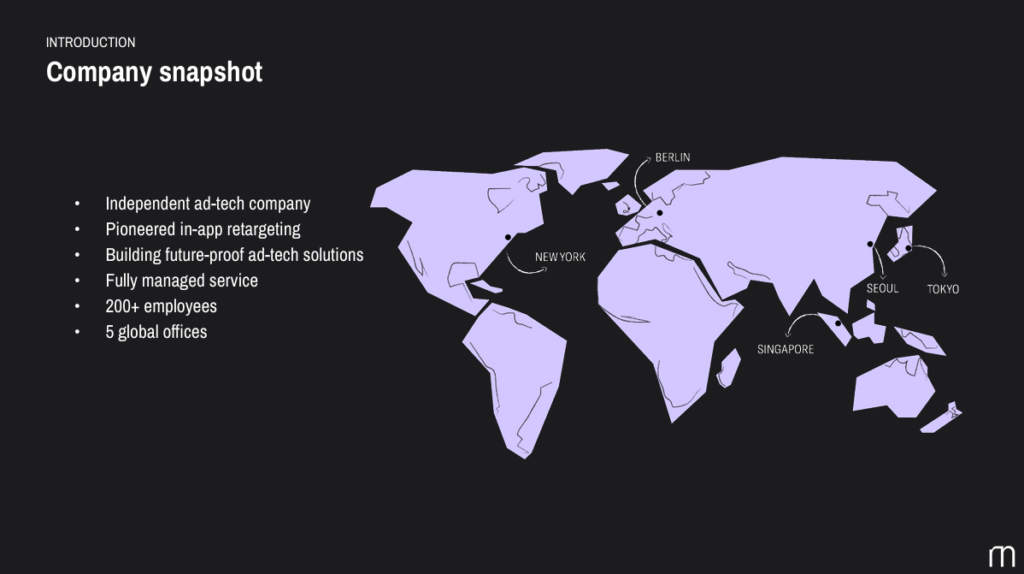
Remerge was founded as a technological pioneer in mobile retargeting, building an independent server infrastructure over the years that is primed for upcoming regulatory shifts across the ad market. Today, the team exceeds 200 high-caliber specialists operating across five global hubs: Berlin, New York, Singapore, Seoul, and Tokyo.
Unlike standard DSPs offering bare self-serve dashboards, Remerge fundamentally adheres to a Fully Managed Service model. Every mobile app is assigned a dedicated expert team – media buyers, data scientists, account managers, and an in-house creative design studio – handling the entire pipeline: from deep link audits and predictive model training to ad design and creative testing.
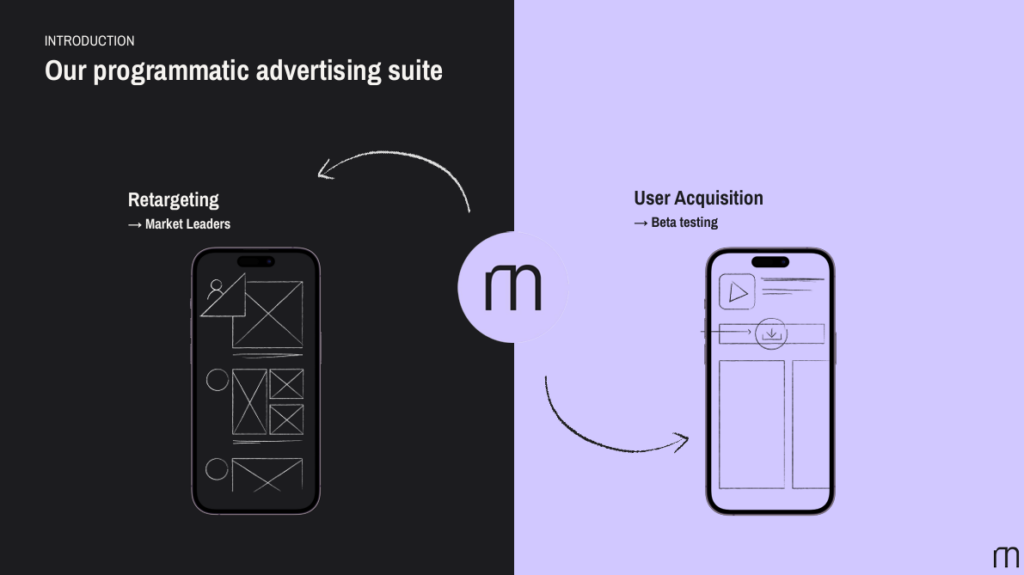
The company’s product suite centers on two strategic pillars:
- Retargeting: The mature, foundational core offering where Remerge holds recognized global leadership.
- User Acquisition (UA): A newer acquisition product currently in active beta testing.
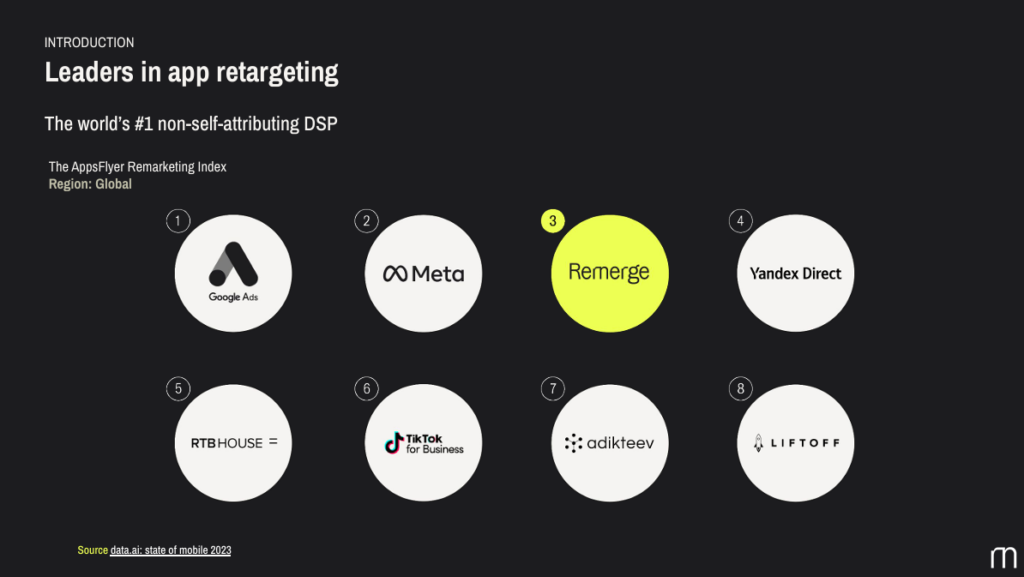
The platform’s technical dominance is highlighted in industry benchmarks such as data.ai: State of Mobile 2023 and The AppsFlyer Remarketing Index, where Remerge was named the #1 non-self-attributing DSP in the world. This establishes it as the premier independent alternative to closed ecosystems (Walled Gardens) like Google Ads and Meta.
Across the broader digital advertising ecosystem, Remerge serves as a trusted partner to tier-1 global brands in Gaming, Delivery, E-commerce, Travel, and Subscriptions. Its roster includes industry giants such as Playrix, Nexon, Devsisters, AliExpress, Delivery Hero, Postmates, Lyft, Tinder, Duolingo, and Pandora.
Market Positioning and the 6-Stage User Re-engagement Cycle
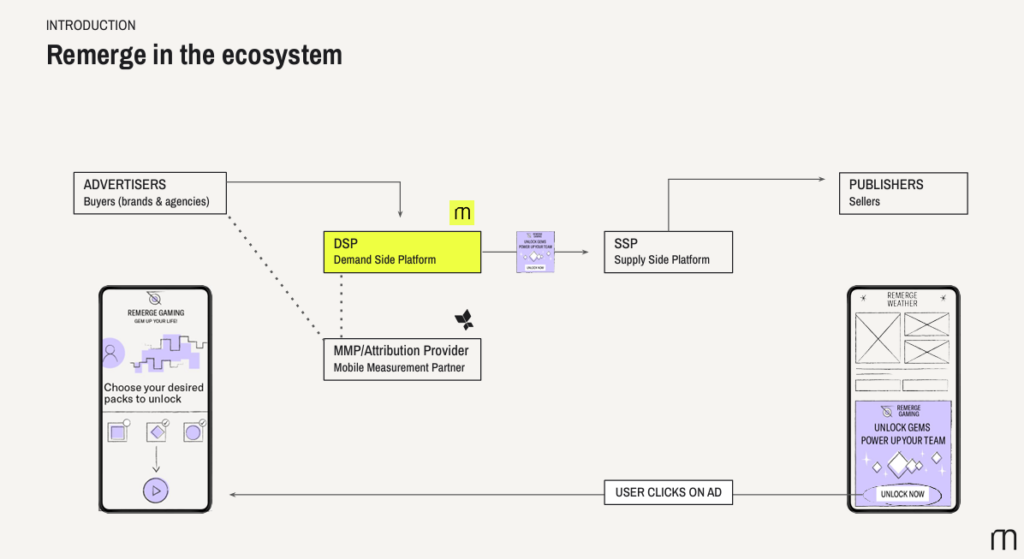
Remerge’s programmatic supply chain integrates seamlessly into standard media procurement flows: advertisers and agencies (Buyers) stream raw attribution data via Mobile Measurement Partners (MMPs); Remerge, as the DSP, ingests and scores these signals, bids across Supply-Side Platforms (SSPs / Sellers), and wins impressions from publishers the moment a targeted user interacts with a third-party app.
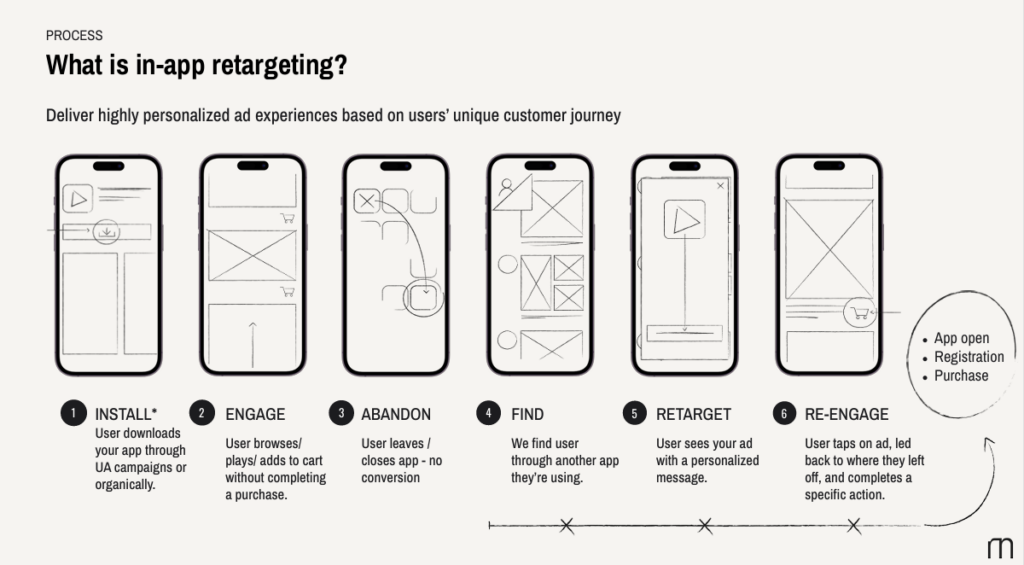
The in-app retargeting workflow delivers personalized ad experiences tailored to individual user journeys through six continuous stages:
- Install: The user downloads the app through paid UA campaigns or organic discovery.
- Engage: The user launches the app, browses catalogs, plays early levels, or adds items to a cart, but stops short of completing a final purchase.
- Abandon: Without converting, the user closes or backgrounds the app, risking permanent churn.
- Find: Remerge locates this exact user inside an entirely different mobile app they have just opened.
- Retarget: The user receives a hyper-targeted ad featuring a tailored offer or a reminder about their unfinished action.
- Re-engage: The user taps the ad, deep-links directly back to the exact relevant in-app screen, and completes the action – logging in, finishing registration, or buying.
Why Retargeting Matters: Core Benefits for Mobile Businesses
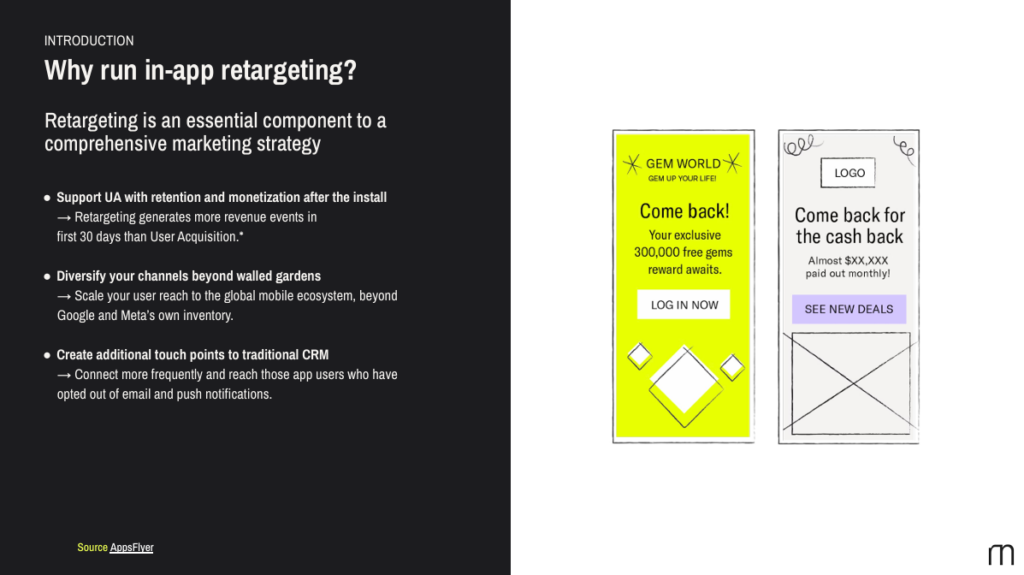
Many marketing teams make the mistake of funneling all capital into top-of-funnel acquisition. Remerge presents clear arguments showing why in-app retargeting is essential for sustainable mobile growth:
- Augmenting UA with Monetization and Retention: Official AppsFlyer data indicates that retargeting drives substantially more revenue-generating events in a user’s first 30 days than pure acquisition campaigns alone.
- Diversification Beyond Walled Gardens: Tapping into billions of global devices outside Google and Meta monopolies mitigates exposure to inflated auctions and margin compression.
- Extending Reach Beyond Traditional CRM: Push notifications and email have hard ceilings – millions of high-value users disable push permissions on first launch or unsubscribe from email lists. Programmatic retargeting re-engages these users across external in-app inventory.
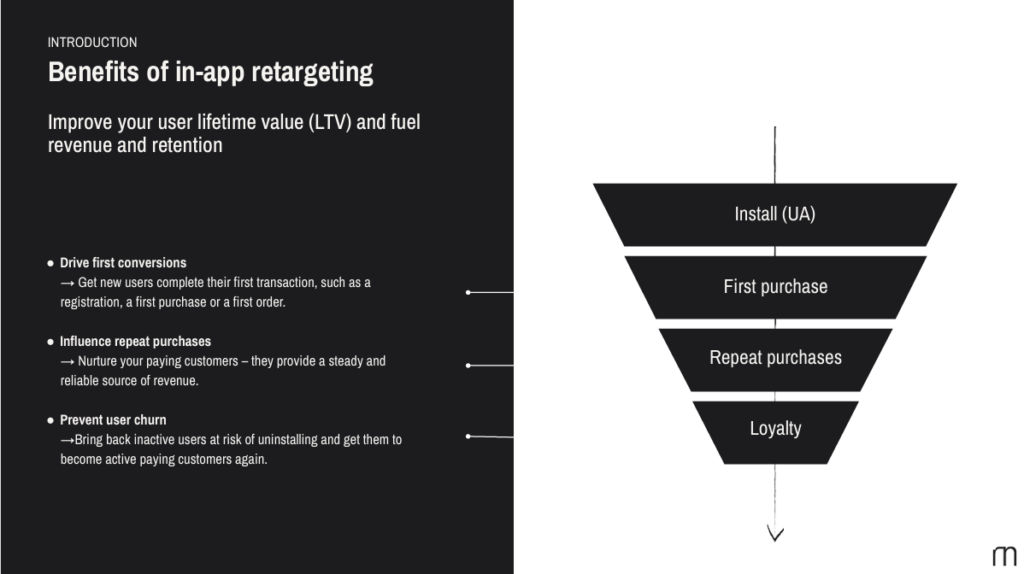
Financially, retargeting drives value across every lifecycle milestone:
- First Conversions: Turning fresh installs into paying customers by incentivizing first registrations, orders, or microtransactions.
- Repeat Purchases: Retaining paying users – the core group responsible for stable, predictable cash flow.
- Preventing Churn: Intercepting slipping cohorts before an app is uninstalled permanently.
Retargeting maximizes efficiency on disciplined budgets: it delivers extreme relevance (serving products and dynamic triggers based on real past events), cost-effective programmatic bidding, and zero exposure to ad fraud, as spend is directed strictly toward real, identified users already registered in the system.
The Post-ATT Status Quo: Debunking the iOS Identifier Myth
Following Apple’s introduction of App Tracking Transparency (ATT), panic prompted media buyers to slash iOS budgets under the assumption that IDFA targeting was dead. Remerge’s Post-IDFA Dashboard demonstrates that ample ID traffic remains available to scale high-return campaigns.
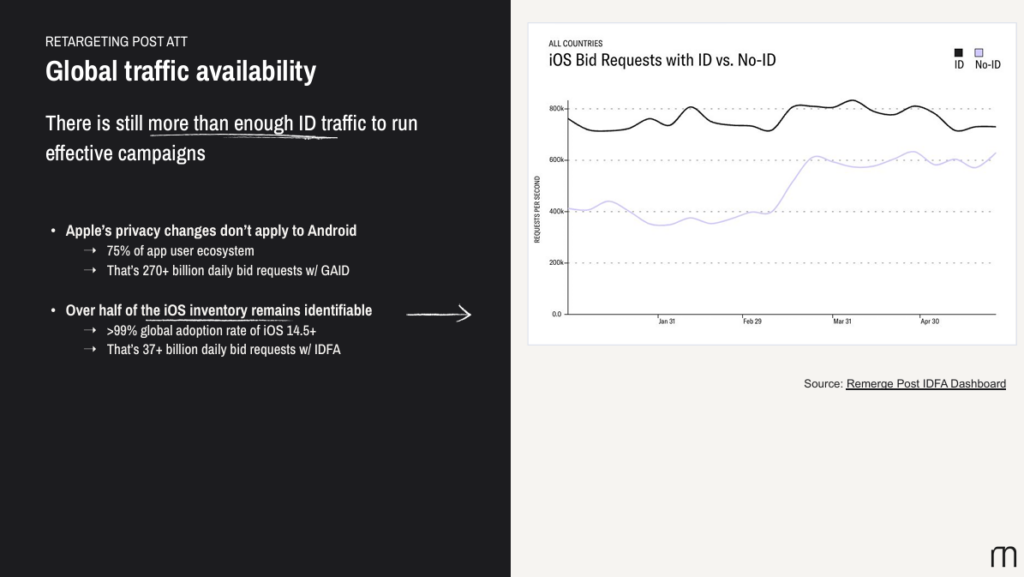
Actual inventory availability breaks down as follows:
- Android Unaffected by Apple Protocols: Android accounts for 75% of the global mobile app ecosystem, providing a massive baseline of more than 270 billion daily bid requests with active GAID.
- iOS Continues to Transmit Identifiers: Even with iOS 14.5+ adoption topping 99%, over 50% of audited key-market inventory continues to pass active IDFA signals. This translates to more than 37 billion daily IDFA bid requests.
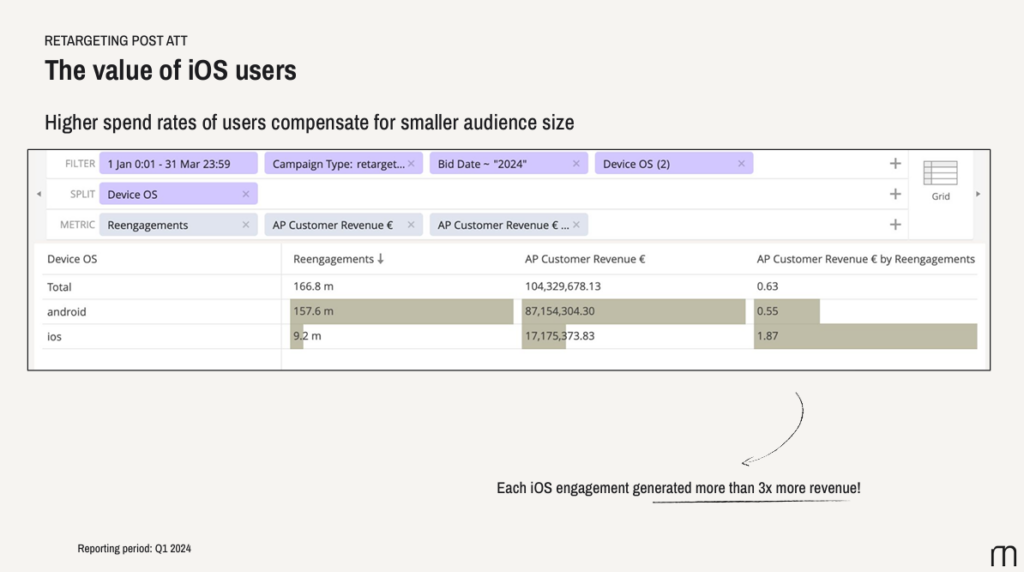
The cohort economics for Q1 2024 highlight an even bigger shift: Apple users exhibit exceptionally high purchasing power, easily making up for smaller audience pool sizes:
- Every interaction (engagement) on iOS generates over 3x the revenue of Android for Remerge clients.
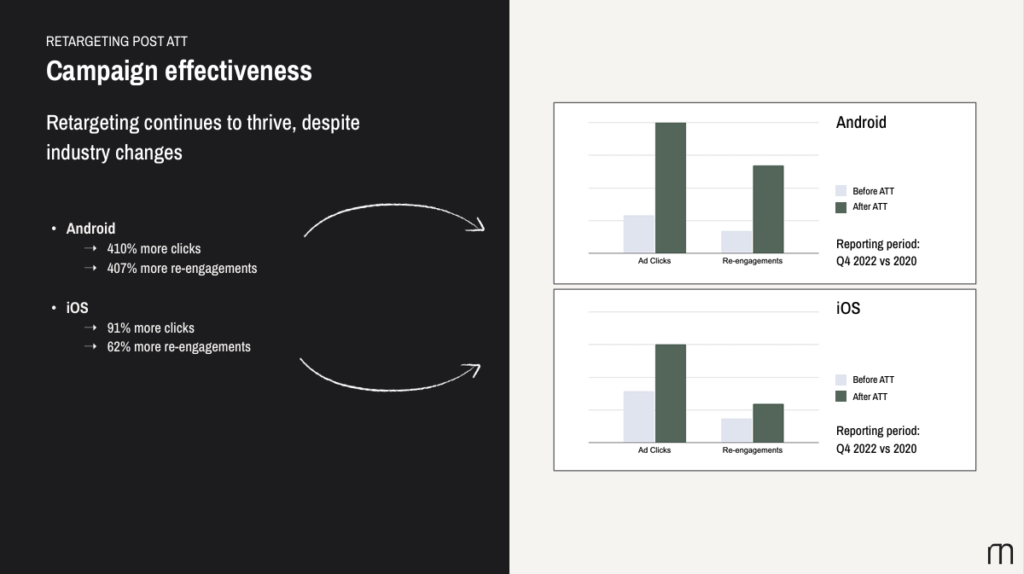
Historical campaign performance (comparing Q4 2022 to pre-ATT 2020) further refutes the stagnation narrative:
- Android: Documented growth of +410% in clicks and +407% in re-engagements.
- iOS: Despite explicit consent prompts, iOS delivered +91% growth in clicks and +62% in re-engagements.
Why Remerge: Technical Infrastructure and 5 Optimization Pillars
Remerge’s scale is anchored by a five-pillar optimization framework: industry-leading bidding capacity, deep segmentation expertise, ML-driven execution, professional creative production, and hands-on campaign management.
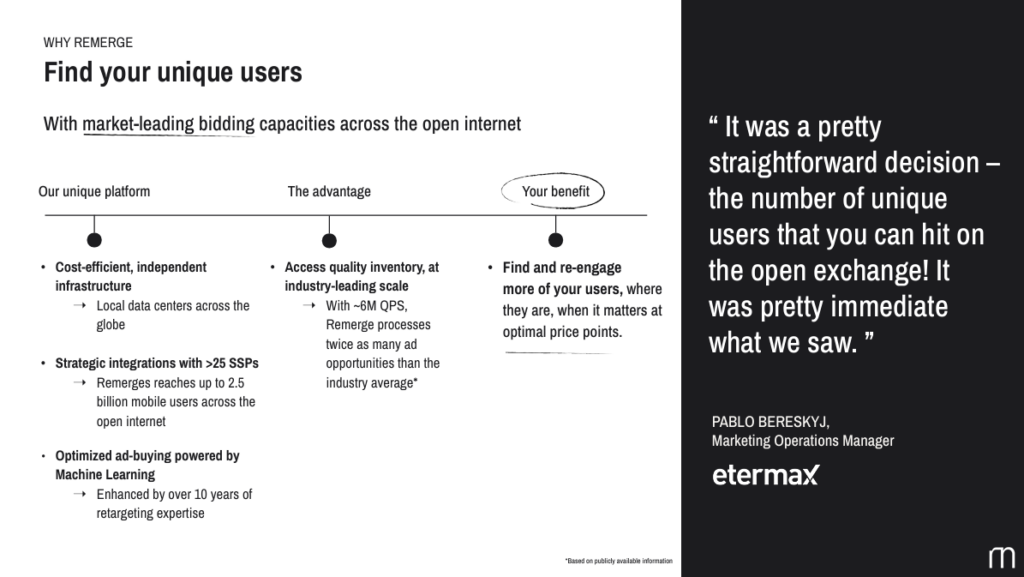
1. Infrastructure and Scale
The platform runs on proprietary on-premise data centers distributed globally. Through direct integrations with 25+ top SSPs, Remerge accesses 2.5 billion mobile users across the open internet.
Network throughput reaches ~6 million QPS (queries per second) – double the throughput of average mobile DSPs – enabling the engine to pinpoint target users at the ideal auction moment and clearing price.
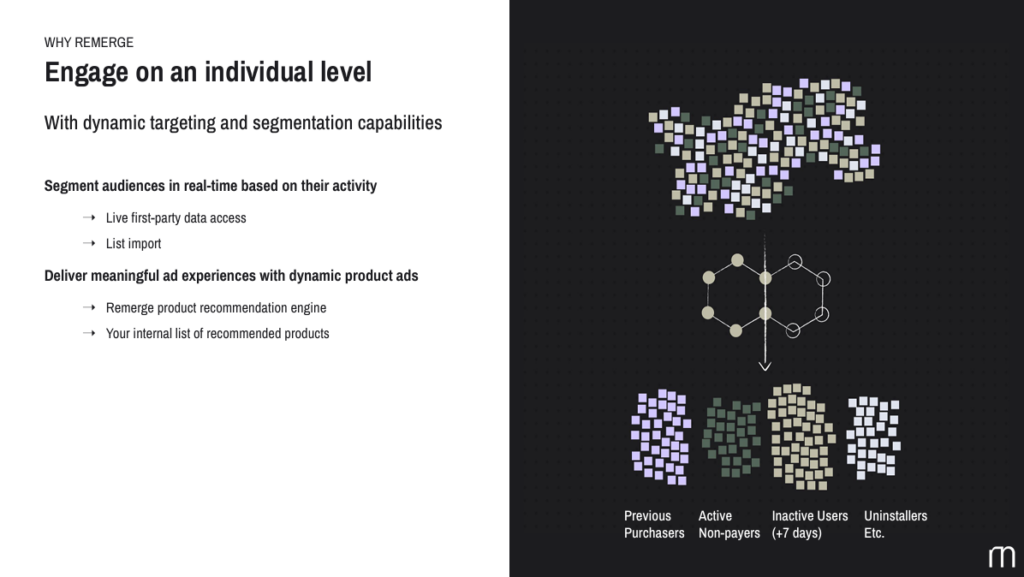
2. Dynamic Targeting and Segmentation
Audience segmentation runs in real time via live first-party data feeds from MMPs or direct cohort uploads. Audiences are split into targeted cohorts:
- Previous Purchasers
- Active Non-payers
- Inactive Users (7+ days churn window)
- Uninstallers, along with custom behavioral segments
For e-commerce and retail apps, dynamic product ads run on the Remerge Product Recommendation Engine, rendering personalized product catalogs directly within banner units.
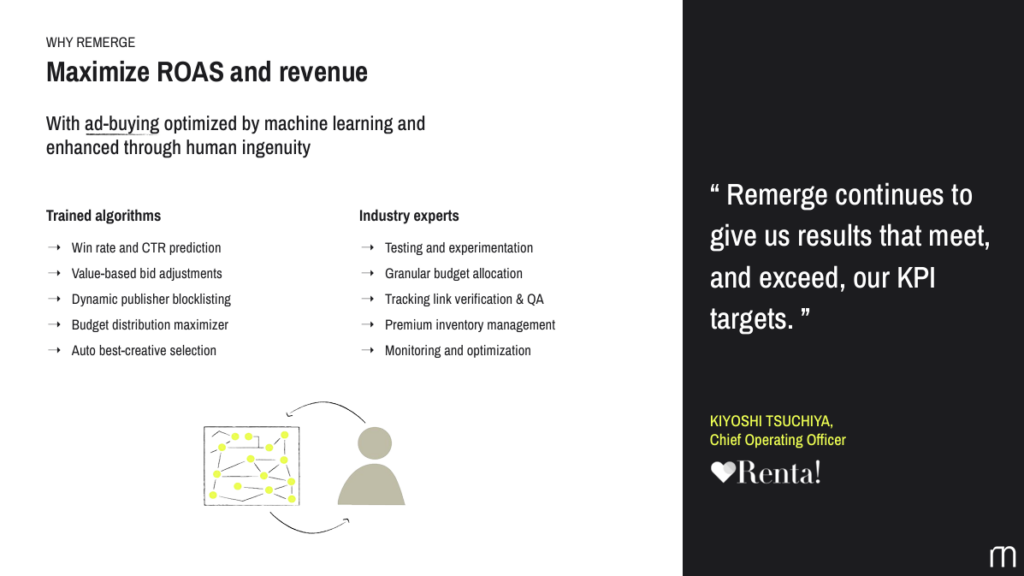
3. Synergizing Machine Learning and Human Oversight
High ROAS is sustained by pairing automated bidding algorithms with seasoned human control:
- Trained ML Models: Calculate win rates and CTR probabilities in real time, apply dynamic value-based bid adjustments, execute automated publisher blacklisting, maximize budget pacing, and prioritize top-performing creatives.
- Industry Specialists: Formulate and test custom hypotheses, manage granular cross-channel budget pacing, execute link QA and tracking validation, secure premium inventory, and run continuous anomaly detection.
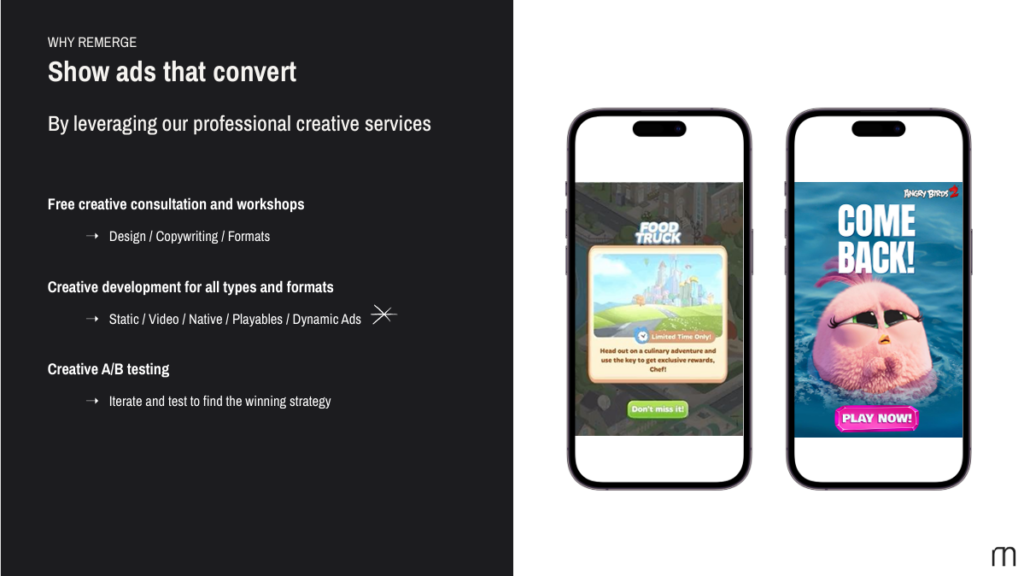
4. Professional Creative Production
Clients receive complimentary creative consulting and format/copywriting workshops. Remerge’s full-cycle creative studio builds all standard formats – static banners, video, native units, playable ads, and dynamic templates – by systematic A/B testing.
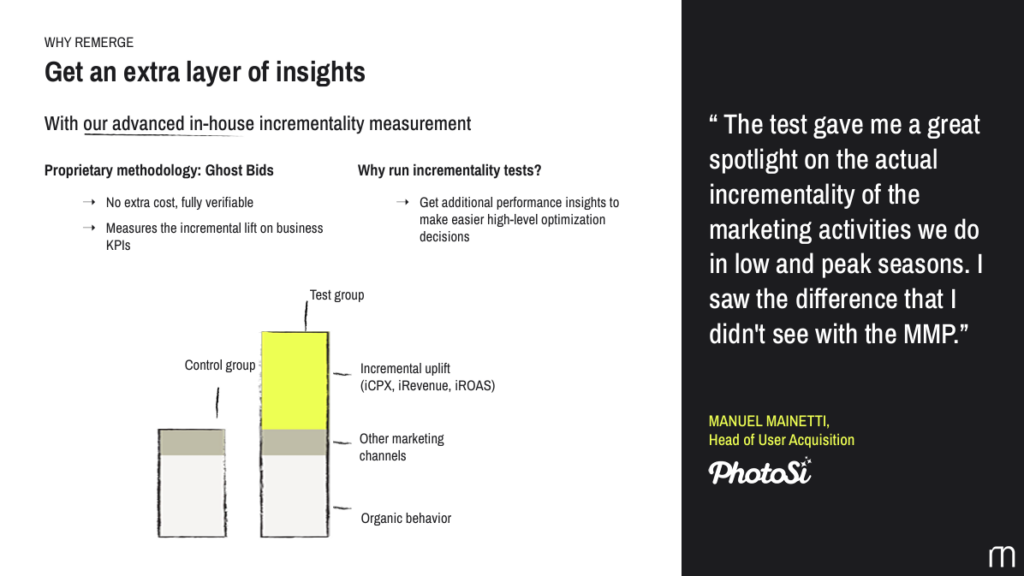
5. Incremental Measurement via Patented Ghost Bids
A primary failure mode in mobile marketing is paying for cannibalized organic traffic – ad networks taking credit for conversions that would have occurred without a paid impression. Standard Public Service Announcement (PSA) control groups force advertisers to burn media budgets on non-functional ads just to benchmark baselines.
Remerge solved this with its patented Ghost Bids methodology built directly into the auction engine:
- Target audiences are split into a test group (exposed to live ads) and a control group.
- When a control group user wins an auction, the algorithm logs a synthetic win (“Ghost Bid”) – recording the auction slot, timestamp, and publisher app without serving a paid banner or billing the advertiser.
- This isolates baseline organic performance and cross-channel overlap, accurately calculating true Incremental Uplift: iCPX (incremental cost per action), iRevenue (pure incremental revenue), and iROAS.
Case Studies
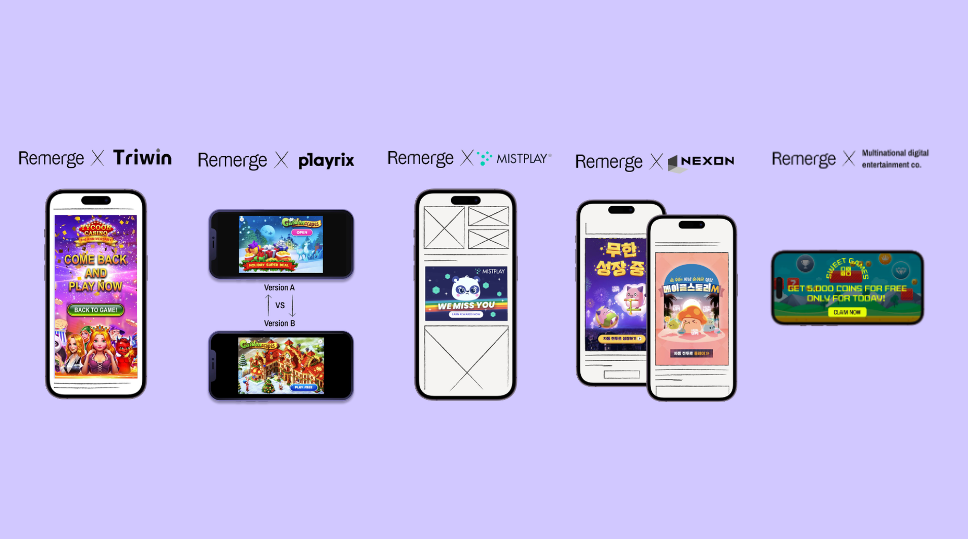
| Client / Vertical | Objective | Strategy & Execution | Measurable Outcome |
| Devsisters (Gaming) | Re-engage churned players in Cookie Run with a 100% ROAS target | Prioritized purchasers across recency and spend tiers; scaled video and static assets via an experimental creative suite | ROAS goal beaten by 2x (+100% over target) |
| Tycoon Casino (Gaming) | Reactivate Android payers and drive FTB among non-payers at 40% ROAS | Segmented inactive high-spenders, low-spenders, and active players with time-sensitive discounts | Reached 55% ROAS (+37.5% over target) |
| Gardenscapes / Playrix (Gaming) | Measure true incremental uplift from retargeting | Split payer base into 10% control and 90% test groups with parallel creative A/B tests | Confirmed 300%–400% Incremental ROAS; +21.4% incremental conversion lift |
| Mistplay (Gaming Loyalty) | Scale app installs while maintaining Day-7 ROAS benchmarks | Segmented new installs, active players, and whales | Maintained 80% D7 ROAS; doubled annual retargeting investment |
| MapleStory M / Nexon (Casual Gaming, KR) | Maximize purchases under strict CPX and D7 ROAS limits via Adjust | 7-day inactivity and spend-level segmentation; automated bidding paired with weekly manual tuning | Android: CPX 52% below target, ROAS +138% iOS: CPX 59% below target, ROAS +51% |
| Matchington Mansion (Gaming, CN) | Drive incremental in-app Android purchases under target margin | Targeted purchasers across inactivity bands (7-14, 14-21, 21-120, and 120+ days); adapted assets across video, native, and static | Exceeded ROAS goal by 12%; expanded contract to onboard Project Makeover |
| Multinational Entertainment Co. (Top Tier Media) | Achieve 30% D30 ROAS among paying gaming cohorts | Dynamic segmentation by spend level (whales vs. standard) and inactivity (3-7 and 7-30 days) with character-unlock ad units | Android ROAS +256% over target; iOS ROAS +299% over target; launched brand’s first-ever FTB campaign |
Future Outlook: R&D, Privacy, and Technical Onboarding
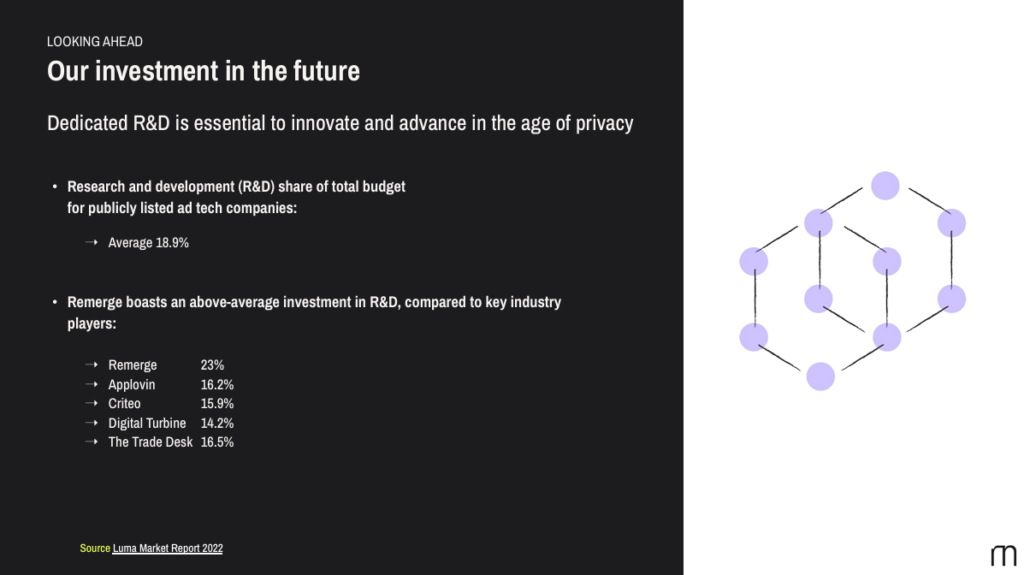
Succeeding amid tighter privacy standards demands heavy research investment. According to the Luma Market Report 2022, public AdTech companies spend an average of 18.9% of operational budgets on R&D (The Trade Desk at 16.5%, AppLovin at 16.2%, Criteo at 15.9%, Digital Turbine at 14.2%). Remerge invests 23% of its budget into R&D, outpacing its primary competitors.
The company’s architecture fully complies with GDPR and CCPA requirements, operating strictly as a Data Processor rather than a Data Controller, backed by NDAs and non-ID solutions: No-ID UA, contextual optimization, and privacy-first incrementality testing.
Best Practices for Privacy-First App Growth
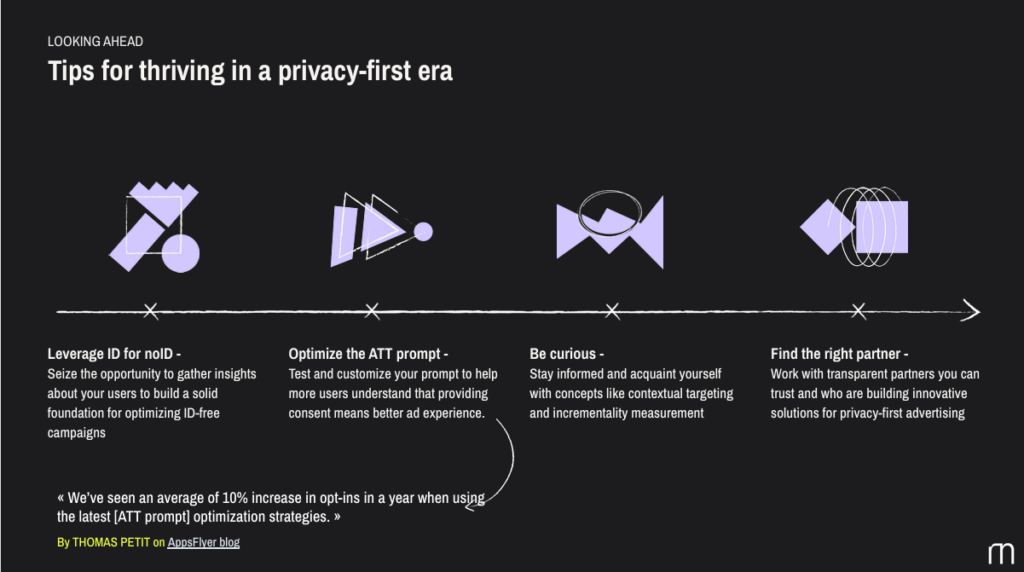
- Leverage ID for No-ID Modeling: Use opt-in cohorts to train behavioral and predictive models that guide anonymous targeting.
- Optimize the ATT Prompt: Refine pre-prompts and onboarding flows to clearly communicate the value of personalization. As shown in Thomas Petit’s research for AppsFlyer, structured ATT optimization yields an average +10% opt-in lift year-over-year.
- Embrace Contextual and Uplift Logic: Prioritize contextual audience relevance and strict incrementality measurement.
- Partner with Transparent Infrastructure Providers: Align with transparent ad partners building infrastructure around evolving privacy standards.
Detailed Appendix: Macro Economics, Apple vs. Google, and Gaming Best Practices
1. Macroeconomic Context and Buying in a Downturn
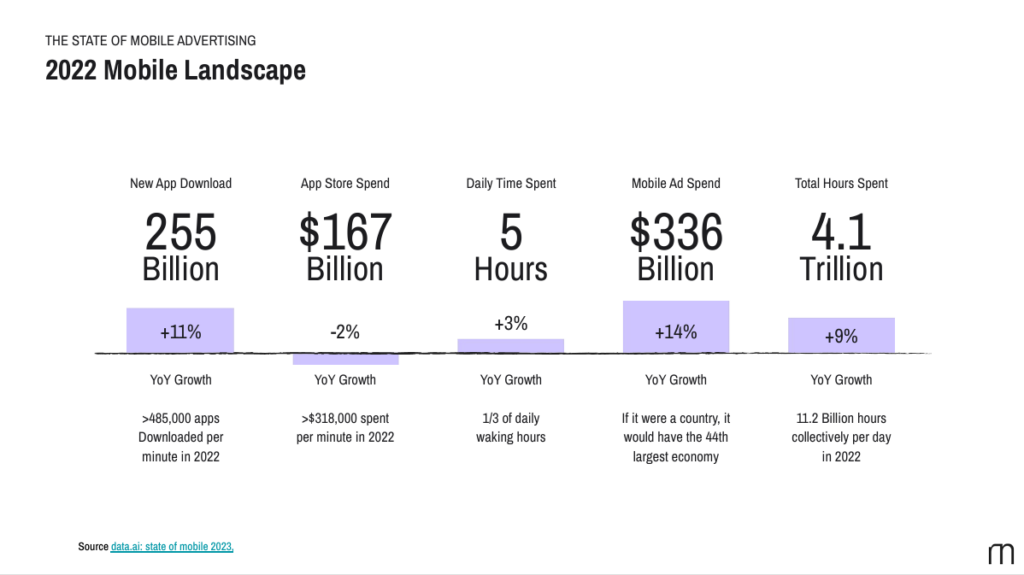
Data from data.ai: State of Mobile 2023 shows strong top-line metrics across the mobile landscape: 255 billion new downloads (+11% YoY, over 485,000 per minute), $167 billion spent across app stores (>$318,000 per minute), 4.1 trillion hours spent in-app (+9% YoY, 11.2 billion hours daily), and $336 billion in mobile ad spend (+14% YoY).
Programmatic spend continues its trajectory toward $550 billion globally, led by mobile at $339 billion. Per IAB Europe, 80% of agencies and 74% of advertisers plan to increase programmatic commitments.
Market downturns also offer strategic advantages to disciplined buyers:
- Bidding competition on open exchanges drops, reducing effective media costs.
- According to the ROI Genome Intelligence Report, 60% of brands that grew media investments during past downturns saw sales rise by 17%. Harvard Business Review research similarly shows that companies maintaining smart marketing investments significantly outperform competitors who cut indiscriminately.
- Internal Remerge open-auction US clearing data from July-October 2022 showed median Buying CPMs halving from $8.00 to $4.00, opening access to high-value cohorts at lower prices.
2. Technical Comparison: Apple ATT vs. Google Privacy Sandbox
| Parameter | Apple ATT (iOS) | Google Privacy Sandbox (Android) |
| Market Status | Launched April 2020 | Staged rollout across modern Android versions |
| Industry Approach | Closed, zero-testing launch creating ecosystem friction | Open, collaborative framework developed alongside industry partners |
| Identifier Fate | IDFA preserved under dual opt-in consent | GAID phased out in favor of on-device cohorts and private APIs |
| Core Mechanics | SKAdNetwork (SKAN); lacks native platform retargeting | Modular APIs: Protected Audience (retargeting), Topics (UA), Attribution Reporting, SDK Runtime |
| Key Advantage | Opt-in rates higher than expected (>50%); SKAN 4.0 expands attribution windows up to 36 days with hierarchical Source IDs | Play Install Referrer remains intact, preserving direct last-click attribution models |
3. Algorithmic Capabilities: Multi-Armed Bandits and Visual Reporting
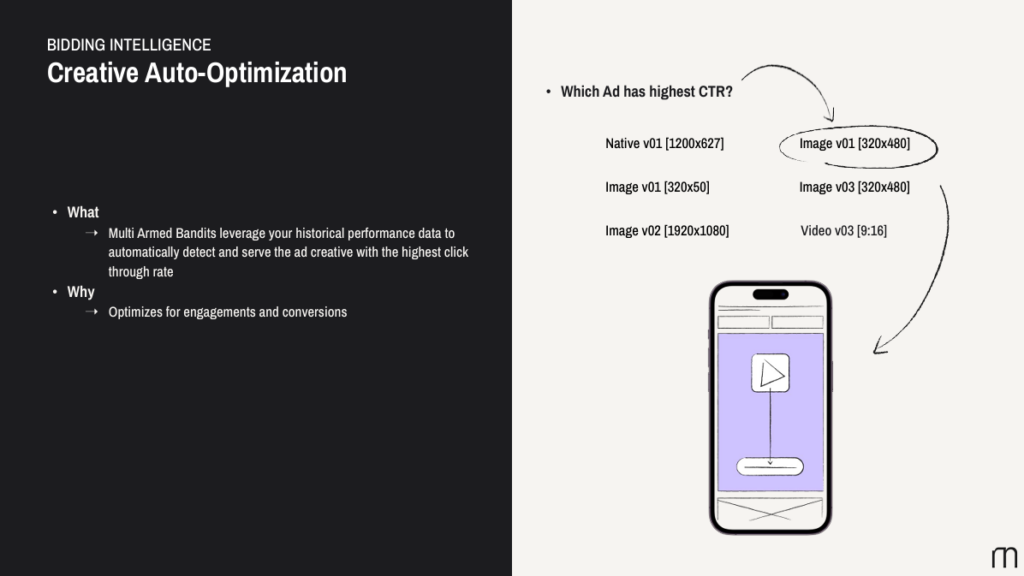
- Creative Auto-Optimization via Multi-Armed Bandits: The bidding engine evaluates conversion and click rates in real time, automatically shifting auction frequency to top-CTR assets. The algorithm continually tests across native units (1200×627), standard banners (320×50, 320×480, 1920×1080), and full-screen vertical video (9:16).
- Visual Reporting Dashboard: Transparent reporting boards match live campaign metrics with real-time visual previews of active video and static assets, letting campaign leads quickly tie creative concepts directly to commercial results.
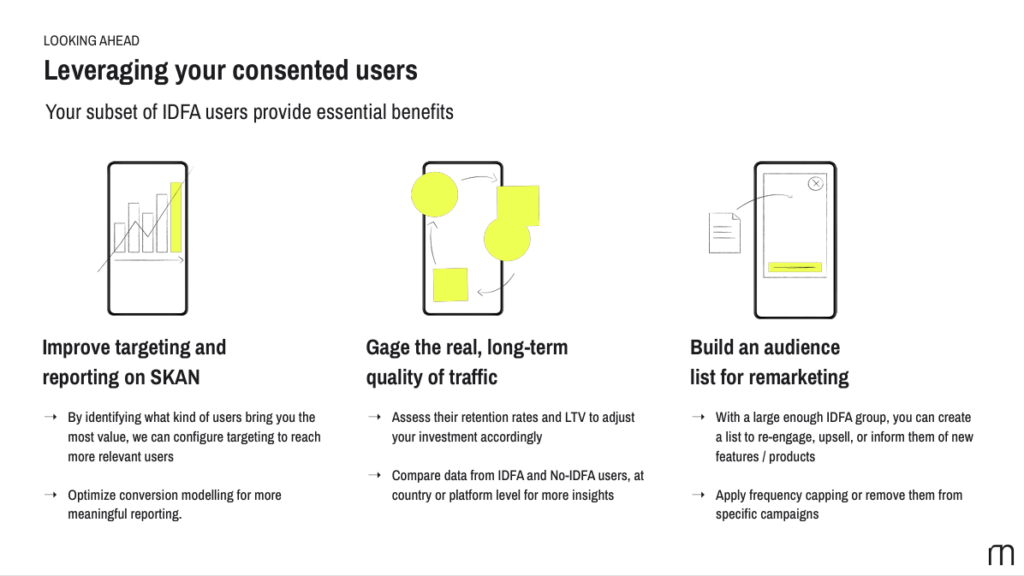
Opt-in IDFA pools are actively utilized to configure SKAN conversion value models, audit actual LTV and retention spreads between ID and No-ID cohorts, and populate targeted re-engagement campaigns.
4. Gaming Playbook: Segmentation, Workflows, and Creative Scenarios
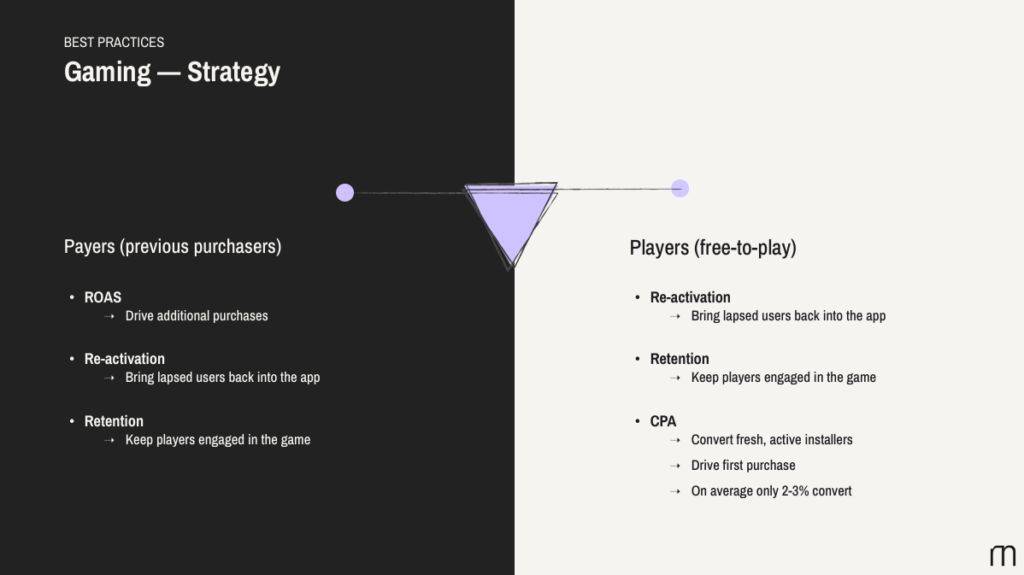
For Casual, Casino, Mid-Core, and Sports genres, Remerge structures campaign operations into clear protocols.
Payer vs. Player Segmentation Strategy:
- Payers (Previous Purchasers): The primary focus is lifting ROAS through repeat transactions and churn prevention. Segmentation factors include recency of last session, recency of purchase, historical order count, and gross spend. Users are bucketed into Low, Mid, and Whale tiers, run on higher CPC caps, higher frequency, and dormancy windows extending up to 60 days.
- Players (Free-to-Play): Aimed at converting active non-payers into their first purchase (FTB). With organic F2P-to-payer rates hovering around 2–3%, non-payers dormant for more than 7 days should never be targeted. Active non-payers (under 7 days since last session) receive lower bids and strictly capped frequencies.
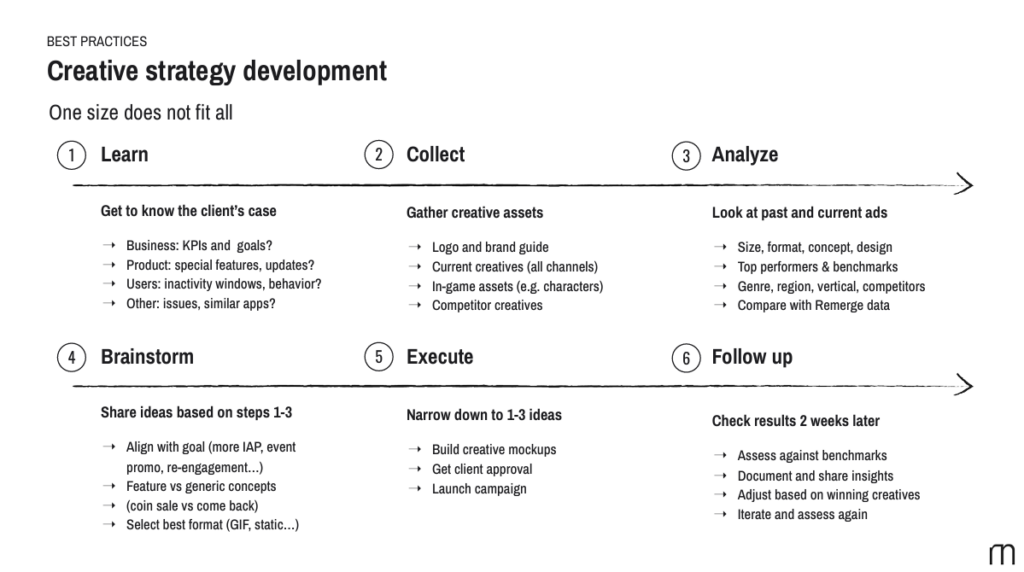
6-Step Creative Strategy Development:
- Learn: Audit goals, target KPIs, game updates, and dormancy behaviors.
- Collect: Gather assets, brand guides, and character kits; analyze competitors.
- Analyze: Evaluate historical performance against vertical benchmarks in the Remerge repository.
- Brainstorm: Match messaging angles (e.g., coin discounts vs. return incentives) to format requirements.
- Execute: Build 1-3 polished mockups, secure client sign-off, and launch.
- Follow up: Review metrics after two weeks, benchmark winners, and initiate new test iterations.
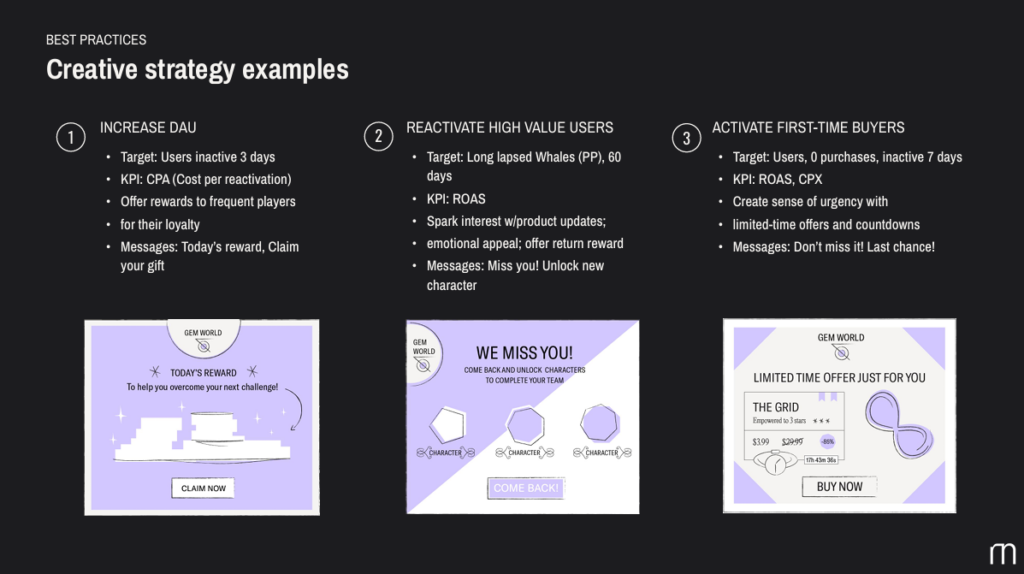
Core Creative Formats & Angles:
- Short 6-second non-skippable video serves as the primary performance driver, reinforced by static and native placements.
- DAU Growth (3-day churn; CPA goal): Loyalty rewards for engaged players – “Today’s Reward”, “Claim Your Gift”.
- Whale Reactivation (Up to 60-day churn; ROAS goal): High-impact creative highlighting game updates and new characters – “We Miss You!”, “Unlock New Character”.
- First-Time Buyer / FTB (0 purchases, <7 days churn; ROAS/CPX goal): Scarcity and time-sensitive promotions – “Don’t Miss Out!”, “Last Chance”.
Remerge pairs massive processing capacity (6M QPS) and access to 2.5 billion users across the open internet with patented Ghost Bids measurement and algorithmic audience segmentation, making it a reliable engine for scaling mobile profitability in an increasingly privacy-focused environment.
Unlock High-Performance Retargeting with ScroogeFrog
Scaling programmatic in-app retargeting via Remerge requires enterprise-level infrastructure, vetted agency credentials, and dedicated account access.
At ScroogeFrog, we provide verified, high-trust Remerge agency advertising accounts along with hands-on onboarding support to help your team deploy campaigns seamlessly, bypass bureaucratic bottlenecks, and maximize your in-app ROAS from day one.
Ready to launch or scale your programmatic retargeting?